NFL Power Rankings 2018: Week 4

Rams logo

1. Los Angeles Rams: 4-0 (Last Week: 1)
Talk about a shootout! Thursday Night Football treated us to a thriller in the Coliseum. It is not there yet, but Sean McVay is starting to form the Greatest Show on Turf 2.0. Jared Goff tore apart the Vikings defense to the tune of 450+ yards and five touchdowns. With the number four scoring defense in the league, LA is the team to beat in the NFL. A win in Seattle could make this division race a formality for the Rams going forward.

Chiefs Logo

2. Kansas City Chiefs: 4-0 (Last Week: 2)
The Monday Night Football stage proved to be just the latest chapter in the legend of Patrick Mahomes. The kid from Texas Tech went over 300 yards again and had two scores. Kareem Hunt had a break out game as well. The defense is still struggling but did just enough for a fourth quarter comeback to be possible. Kansas City has a massive matchup with Jacksonville ahead. Top scoring defense, meet top scoring offense. Something has to give.

Jaguars logo

3. Jacksonville Jaguars: 3-1 (Last Week: 4)
It wasn’t always pretty, but the Jaguars won it going away against the Jets. Blake Bortles had another stellar day. Jacksonville leads the league in just about every meaningful statistical category on defense. The concern was the turnovers. The Jags had three of them without forcing one from New York. The Jets aren’t enough of a threat on offense for that to matter, but that is something Doug Marrone is going to have to fix heading into a matchup with the Chiefs.

Patriots Logo

4. New England Patriots: 2-2 (Last Week: 6)
What’s that? It’s been 8 years since anyone won the AFC East over the Patriots? Right. New England smacked Miami 38-7, silencing all of the talk about the end of an era. This team is not as talented as in years past, but still more than good enough to win the division. The Pats get Julian Edelman back this week as it gets set for to host Indy on Thursday night.

Bears logo

5. Chicago Bears: 3-1 (Last Week: 7)
All of a sudden, Chicago is having some flashbacks to the 2006 NFL season when an incredible defense carried it to a Super Bowl appearance. This time though, Da Bears have a much better quarterback than Rex Grossman. Mitch Trubisky launched six touchdown passes in a rout of the Buccaneers. Matt Nagy almost has to feel disappointed his team is off this week after firing on all cylinders against Tampa.

Ravens logo

6. Baltimore Ravens: 3-1 (Last Week: 8)
Baltimore took care of business on Sunday Night Football, winning the best current rivalry in the NFL. Joe Flacco played great and the Ravens defense shut down the high-powered Steelers offense. Jim Harbaugh’s defense is giving up the second fewest yards and third fewest points per game. The next step for Baltimore is finishing drives with touchdowns. Justin Tucker kicked four field goals in the second half.

Vikings logo

7. Minnesota Vikings: 1-2-1 (Last Week 5)
It would be really easy to look at the scoreline and think the Vikings just aren’t as good as a year ago. Minnesota played a much better football game on the road with a short week against the best team in the league. At the same time, the Vikings are one Clay Matthews roughing the passer penalty away from being 1-3. The schedule doesn’t get much easier as Mike Zimmer prepares for a road trip to Philly for a rematch of the NFC title game.

Eagles Logo

8. Philadelphia Eagles: 2-2 (Last Week: 3)
The message so far has been to wait until this team gets healthy. It might take a bit of time for all those previously injured players to gel again as the Eagles drop another close game on the road. Looking at the box score, its tough to figure out where Philly faltered after posting 432 yards of offense and forcing a turnover on defense. The biggest issue was Tennessee going 3-3 on fourth down, all of them coming in overtime. Doug Peterson has some soul searching to do as the Vikings come to town desperate for a win.

Saints logo

9. New Orleans Saints: 3-1 (Last Week: 15)
The Saints are at their best when they run the ball efficiently. It keeps the defense off the field and allows Drew Brees to utilize the play action passing game. In fact, they were 9-1 last season when eclipsing the 100-yard mark on the ground and 3-5 when failing to top 100 yards. Efficiently is putting it mildly as well after averaging 5.3 yards per carry against the Giants. Alvin Kamara had a field day with 181 yards from scrimmage and three touchdowns. Mark Ingram also returns from suspension this week as New Orleans heads home to host Washington.

Panthers logo

10. Carolina Panthers: 2-1 (Last Week: 10)
An early off week for the Panthers allows them to hopefully solve a few of the issues plaguing the secondary. It will start by taking the week to integrate newly-signed safety Eric Reid. Carolina gave up the third most yards per play in its first three games. The cure for that might be the struggling Giants offense, who visits this week after managing only 18 points against what has been a terrible Saints defense this season.

Bengals Logo

11. Cincinnati Bengals: 3-1 (Last Week: 16)
With several games heading to overtime, the Bengals might have played in the best game of the weekend and it finished in regulation. Beating the Falcons in Atlanta is a big statement for Cincy. The secondary needs to step up after allowing 432 yards passing and three touchdowns. The Bengals have also allowed opponents to convert 57 percent of their third downs, the worst mark in the league. Cincinnati has the firepower, now the defense needs to take some pressure off Andy Dalton until Joe Mixon is back.

Packers logo

12. Green Bay Packers: 2-1-1 (Last Week: 12)
Aaron Rodgers said the Packers were terrible following a shutout over the Bills. The offense might not have been great, but the defense played lights out. Green Bay sacked Josh Allen seven times, forcing a fumble, and picked him off twice. Buffalo only mustered 145 yards of total offense. For a team that has struggled on defense this season, these are all good signs.

Falcons logo13. Atlanta Falcons: 1-3 (Last Week: 11)
Another week, another heart-breaking close loss for the Falcons. The Bengals have looked sharp this season on offense, so the struggles on defense are somewhat understandable, especially given how many injuries the team has suffered. Calvin Ridley also continues to emerge for the offense. Scoring points isn’t the problem. Dan Quinn needs to return to his defensive roots and find ways to hide its weaknesses on that side of the ball.

Washington made up logo

14. Washington: 2-1 (Last Week: 14)
The week off couldn’t have gone much better for Washington. Both the Eagles and Giants lost. The Cowboys failing in their late comeback would’ve been the icing on the cake, but Washington is still atop the division. It has a tough week ahead with the Saints on Monday night, but Jay Gruden got an extra week to find ways to slow down this New Orleans offense.

Titans logo

15. Tennessee Titans: 3-1 (Last Week: 20)
Mike Vrabel showed everyone that he has the guts to win football games as a head coach in the NFL. The Titans converted on three fourth downs in overtime to topple the defending champs. The offense took a little while to get going, but Marcus Mariota finally scored a touchdown. It was a poor game plan from Philly, but Vrabel and his staff put together a great game plan to maximize what little talent it has at the skill positions on offense. The Titans are going to be tough to beat.

Pittsburgh_Steelers logo

16. Pittsburgh Steelers: 1-2-1 (Last Week: 9)
It is time to consider that maybe the Steelers just aren’t that good. Ben Roethlisberger missed open receivers and for the first time this season, Pittsburgh really missed Le’Veon Bell, who announced he will return during week 7. The defense actually improved in a bend don’t break sort of way, but this team has a lot of questions and not too many answers after four weeks of football.

Dolphins logo

17. Miami Dolphins: 3-1 (Last Week: 13)
Dolphins, meet Earth. Miami came down hard in a blowout against New England. Ryan Tannehill accomplished nothing under center, the running game was MIA and, despite two interceptions, the defense was gashed by Patriot running backs all game long. The Dolphins proved to everyone they are not a contender, not even really close to one, with that loss.

Denver_Broncos

18. Denver Broncos: 2-2 (Last Week: 18)
Denver came agonizingly close to an impressive upset. The ground game and defense powered the Broncos to a 23-13 lead, but faltered down the stretch when it mattered most. This is a gritty team capable of hanging with the top teams in the league. Case Keenum needs to make more plays to push the Broncos over the hump from just competing to winning.

Chargers logo

19. Los Angeles Chargers: 2-2 (Last Week: 19)
This was bad, but it could’ve been worse. The Chargers squeaked out a win over the battered 49ers. Los Angeles showed heart in the comeback, but it should never have been required. The defense allowed too many big plays and could struggle again with the Raiders coming to town after finally showing up on offense.

Seahawks logo

20. Seattle Seahawks: 2-2 (Last Week: 22)
Seattle is an entirely different team on the road. It played poorly enough to lose to Arizona, but the Cardinals couldn’t get out of their own way to pull off the upset. The one positive is the Seahawks looked comfortable running the ball even without Chris Carson. They head home for a date with the Rams and a chance to pull off a major upset. No matter how shaky Seattle might be, going to CenturyLink Field and winning is still one of the hardest things to do in football.

Cowboys logo

21. Dallas Cowboys: 2-2 (Last Week: 23)
Ezekiel Elliott is making a legitimate case for the MVP award this season. The former Buckeye leads the league in rushing by almost 100 yards through four weeks. He is also second in yards from scrimmage only behind Alvin Kamara. The reason MVP might be in order is only Cole Beasley has more receiving yards for Dallas this season. Zeke is doing it all right now for the Cowboys, who might need his heroics again in Houston to go above .500.

Buccaneers logo

22. Tampa Bay Buccaneers: 2-2 (Last Week: 17)
Goodbye FitzMagic, hello quarterback controversy. Neither Ryan Fitzpatrick nor Jameis Winston played well in a 48-10 laugher against the Bears. The Bucs defense picked up right where it left off, which is giving up massive gains through the air and occasionally frustrating running backs. This is much more the Tampa team many expected to see this season, and it could cost Dirk Koetter his job.

Colts logo

23. Indianapolis Colts: 1-3 (Last Week: 21)
After a tough start, the Colts really turned things around to force overtime and almost pull off the comeback. Andrew Luck put up great numbers, but still does not look like the same quarterback he was before his injury. The running game didn’t produce much, but Nyheim Hines caught a pair of touchdowns out of the backfield. Frank Reich has achieved some positive things in Indy, but the Colts have a long way to go.

Giants Logo

24. New York Giants: 1-3 (Last Week: 24)
The Giants limited Drew Brees and Mike Thomas, but totally forgot about Alvin Kamara, letting him rumble for 181 yards of offense and three touchdowns. Offensively, New York has not threatened to throw it downfield and cannot find a way to establish a consistent running game. It seems like the Giants need to start thinking about the future, looking for a long-term answer at quarterback and completely rebuilding this offensive line.

Lions Logo

25. Detroit Lions: 1-3 (Last Week: 25)
Going into Dallas to earn a win after pulling off a major upset against New England would have caused many to forget the woeful start to the season. Instead, the Lions are 1-3 and seem unsure how to utilize the talent they have. Kerryon Johnson did not get the ball enough against the Cowboys and Matt Stafford continues to do a lot. The defense had no answer for Ezekiel Elliot though. With Green Bay visiting this week, Detroit needs to have a much better game plan.

Browns logo

26. Cleveland Browns: 1-2-1 (Last Week: 26)
Heading to the West Coast is really tough. There is a lot to take away from this game. The positives are the offense can score a ton of points and the defense can generate turnovers. The negatives are the defense can give up a ton of points and the offense can commit a lot of turnovers. If Baker Mayfield can find some ways to clean up his game (four turnovers in Oakland), the Browns should start winning games.

Texans logo

27. Houston Texans: 1-3 (Last Week: 28)
It required a bit of luck, no pun intended, to beat the Colts after Indy failed to convert from midfield on fourth down. That set up the Texans for the game-winning field goal in overtime. Deshaun Watson played great. J.J. Watt and Jadeveon Clowney combined for four sacks. However, the secondary gave up over 450 yards and four touchdowns. The task this week will be containing Ezekiel Elliott.

Jets logo

28. New York Jets: 1-3 (Last Week: 27)
It is games like these that set the Jets back a few years. Todd Bowles seems to be trending ever closer to an exit in New York. Blake Bortles tore apart the Jets defense and New York never adjusted. Bowles continues to blitz on third down in any part of the field and Jaguars were ready for it every time. It is hard to fire a coach after drafting a rookie quarterback, but for the sake of Sam Darnold’s development, the Jets are better off doing it this year rather than waiting.

Raiders logo

29. Oakland Raiders: 1-3 (Last Week: 31)
At times, it seems like the Raiders are trying to lose. Oakland made a ton of mistakes on both sides of the ball and benefitted from several questionable calls by the officials. Still, it was a win nonetheless, Jon Gruden’s first in ten years. The Raiders offense showed up against what had been a good Browns defense. Oakland is going to need the offense to keep clicking to even have a chance with how poorly the defense continues to play.

49ers Logo

30. San Francisco 49ers: 1-3 (Last Week: 30)
For those who thought San Francisco would just go quietly into the night after losing Jimmy Garoppolo, this was a big surprise. The 49ers came extremely close to knocking off the Chargers. C.J. Beathard knows this offense well after starting several games last season. It is unlikely Kyle Shanahan and company win a ton of games the rest of the way, but they seem like they will at least be competitive.

Bills logo

31. Buffalo Bills: 1-3 (Last Week: 29)
Reality set in once again for the Bills after shocking the Vikings at home in week 3. Josh Allen is still a rookie and this offensive line still isn’t good. Green Bay sacked Allen seven times in the contest. If Buffalo cannot find a way to keep the kid from Wyoming clean, he will continue to force the errors we saw in the second half in Green Bay.
Arizona_Cardnals_logo_(1994-2004)

32. Arizona Cardinals: 0-4 (Last Week: 32)
Quietly, Josh Rosen might have had the best week of any of the rookie quarterbacks who started. He only threw for 180 yards and a touchdown, but he considering the Cardinals dropped at least three passes in the game and Phil Dawson missed two field goals, he did a lot to put his team in a position to win. It was improvement from the previous week in Chicago which featured an awful final few minutes for the kid from UCLA. If David Johnson can get on track, this Cardinals offense should be decent at least with Rosen at the helm.
The Collapse of the Oakland Raiders

In 2016, the Oakland Raiders were finally back. After 14 years without a winning record, the Silver and Black went 12-4 and returned to the playoffs for the first time since losing to Tampa Bay in the Super Bowl. This was a team on the rise. They had a young stud at quarterback. They had a defensive player of the year. They had a brash coach who was unafraid to gamble with the game on the line. It seemed like the Raiders were once again in the mix to compete for a championship.

DeAndre Washington, Derek Carr
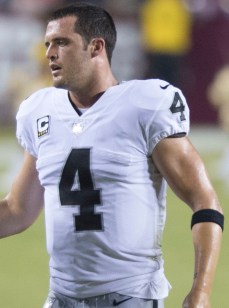
Carr is already fourth in franchise history for passing yardage and touchdowns in just his fifth season. (Wikimedia Commons)

That 2016 season ended in bitter disappointment. Third-year quarterback Derek Carr suffered a season-ending injury in week 16. The Raiders lost their final regular season game with rookie Connor Cook under center. That loss cost Oakland the division and a first-round bye in the playoffs. Instead, the Raiders had to travel to Houston to play against the vaunted Texans defense in the Wild Card round. Cook struggled mightily in the game and the Raiders lost 27-14, ending their season.

Many felt that had Carr stayed healthy, that team could have made a deep run in the postseason. After all, Oakland had seven Pro Bowlers and three players named to the AP All-Pro team. Still, despite the abrupt end to the season, it seemed like the Raiders were poised for another great season in 2017.

That great season never came. Oakland struggled through the 2017 season, facing a much tougher schedule. The 2016 Raiders had the 15th hardest schedule in the league. The 2017 Raiders had the fourth. Injuries limited the team as offensive tackle Donald Penn finished the season on IR. So did Oakland’s first two picks in the 2017 draft. Oakland still had bright spots. Khalil Mack dominated, becoming the first player ever to be named first-team All-Pro at two different positions in the same season.

However, in addition to the tougher schedule, there are some easy things to point to as the reason for regression. The offense fell off a cliff. The Raiders gained 50 fewer yards of offense per game and scored eight fewer points per contest. Not exactly a recipe for success. Oakland also went from the top team in turnover ratio in 2016 to tied for 29th in 2017. That was a swing over 30 possessions, roughly two per game. That could help explain some of the scoring and yardage difference.

After a 6-6 start, the Raiders finished the season on a four-game losing streak. That cost Jack Del Rio his job as the head coach. Little did we know, he would be the first of many crucial pieces to leave Oakland.

jon_gruden2
Gruden is 101-88 in his career as a head coach, including the playoffs. (Wikimedia Commons)

It ended up being a tumultuous offseason for the Raiders. During the 2017 season, the team announced it would be moving to Las Vegas for the 2020 season. The fan base was already unsettled as a result. Then the Raiders signed Jon Gruden to a massive deal, reportedly worth about $100 million over 10 years.

Here’s the thing, Gruden hasn’t coached a football team in 10 years. His last gig was as the Buccaneers coach from 2002 to 2008. He did win a Super Bowl during that first season, beating none other than the Oakland Raiders.

The move made a lot of sense from the story perspective. Gruden had been the head coach of the Raiders 1998 to 2001, only to be forced out by former Raiders owner Al Davis. Gruden has said he feels like there is a lot that he would like to do to finish his legacy in Oakland.

When you pay a coach that much money though, it makes it really difficult to explain to your players that you can’t pay them. The team elected to extend Derek Carr’s contract with a lucrative deal that was the richest in NFL history for a short period of time. It seemed like the logical move, until the consequences quickly followed.

khalil_mack
Mack signed a six-year $141-million contract, the richest for a defense player in NFL history, after joining the Bears. (Wikimedia Commons) 

Khalil Mack is one of the best defensive players in NFL history, yet the Raiders did not pay him. Mack held out all summer long in hopes of landing a new contract. It never came, at least not from Oakland. Just before the start of the season, Gruden shipped Mack to Chicago for a package of draft picks. Mack has been a beast through the first four weeks of the NFL season. He is tied for second in the league with five sacks. He also leads the league with four forced fumbles alongside J.J. Watt, and has an interception.

The loss of Mack leaves the Raiders seemingly in a rebuild mode. Oakland has started the season 1-3 and shows no signs of turning it around. It needed overtime and a bit of assistance from the officials to pull off the victory and avoid what would have been a truly terrible start to 2018. The Raiders have scored the fifth fewest points this season. Apparently, Gruden does not really know how to rebuild either.

Thinking about it, it’s not too shocking considering this is a franchise known for the mantra “Just Win Baby.” The Raiders were never good at rebuilding. They struggled to do so for the aforementioned 14 years without a winning record. Oakland failed to draft well or attract free agents to help turn the franchise around. The environment for this Raiders franchise has been toxic for years. Even when it did bring in top-tier talent, like Randy Moss or Charles Woodson for the second time, it couldn’t convert that into true success. Looking at this Raiders team now, one that is going to require a ton of roster turnover and a general talent overhaul, Gruden has not positioned himself to rebuild in the coming years.

Oakland has the oldest roster in the NFL. The Raiders on average are 27.32 years old, according to Spotrac. The next youngest team is the Atlanta Falcons at 27. Oakland is more than a full year older than the league average. It also has the most players signed over the age of 30. Gruden has built a team ready to win this season, but it will come nowhere close to even making it to the playoffs. Gruden is also burying Marquel Lee and Karl Joseph, young players with bright futures, on the depth chart.

At this point just two years ago. The Raiders were 3-1 and seemed like a team destined to compete for the next several years. Today, this team is years away from competing. Gruden has one hell of a task ahead of him and this organization has some explaining to do as to how quickly it let the team fall into turmoil.

Countdown to the “Impossible”: Breaking the 2 Hour Barrier

Impossible is a word we throw around a bit too often. How often have you heard a cheesy movie villain, having been foiled, scream out, “That’s impossible!” as his well-laid plans fall to shreds? Even in the real world, many times people have said things could not be done, and then been proven wrong.

Sail west? Impossible – until Christopher Columbus did it.

Walk on the moon? Impossible – until Neil Armstrong did it.

That math homework you have due tomorrow? That may actually be impossible after all.

Sports have lent us a few of these moments as well, where we mistook improbability for impossibility and were dumbfounded by truly amazing achievements, such as Michael Phelps winning 8 gold medals in Beijing, or Leicester City winning the Premier League in 2016 at 5,000-1 odds at the start of the season. Some people have even said the Cubs breaking their 108-year curse, or Tiger winning another golf tournament, could never happen, and don’t they look foolish now?

There have even been times in history where science–science–said a feat could not be accomplished, which brings me to my obscure sport of preference: distance running. For all the times you probably ran the mile in grade school gym class, huffing along wishing you could run faster just to make the pain stop, you probably never thought that at one point in history, scientists declared that a human could not possibly run faster than four minutes for a mile. Based on their calculations of human lung capacity and pain tolerance, no man could maintain the pace needed to run four consecutive laps at a sub-60 second clip. It was a feat deemed impossible.

gladwell-the-ordinary-greatness-of-roger-bannister
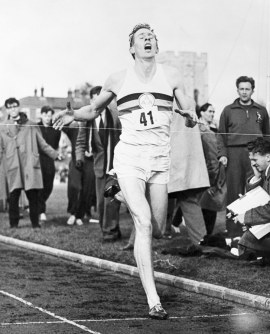
Sir Roger Bannister, finishing the world’s first sub-4 mile, 1954

The knight that saved us from this horror? Sir Roger Bannister – an actual knight! In 1954, he made the impossible happen by running 3:59.4 for the full 5,280 feet and etched himself in history, which is why the Queen knighted him in 1975.  And just like you often see, if someone else can do it, so can you. Within 6 weeks of Sir Roger setting the record, it was broken again, and everyone was  striving to reach the now-attainable mark.  On February 14th, 2015, 19 runners broke 4 minutes on the same day – my friend from Duke was the slowest of the bunch, but still, he gets to tell everyone that he did what once was deemed impossible. And believe me, he does tell everyone.

Why does this matter now? Because the next impossibility in running is oh-so-close to being blown away: the 2-hour marathon. People in the running community have had their sights set on this for a while now, thinking it would be the next barrier to go, but that does not take away from the sheer madness of running 26.2 miles in under 120 minutes.

If you’re reading this and not a running nerd like I am, and I know just about all of you aren’t, here’s some context. To run exactly 2:00:00 for a marathon, you need to maintain an average pace of 4:34.8/mile. There are very few people on this planet who could run that pace for 26.2 seconds, let alone miles. Makes that gym class mile sound a lot easier, huh?

But people believed the impossible could happen. A few of them happened to work at Nike, so they set up a challenge back in 2017.  They brought three of the best marathoners in the world at that time – Eliud Kipchoge, Lelisa Desisa, and Zersenay Tadese – to a flat track with a pace car going the exact pace for the entire time, gave them prototype shoes lighter and more advanced than any road racing shoe ever before created, and let them do their thing. But even in the perfect circumstances of that day, they fell short, albeit barely – Kipchoge ran the distance in 2 hours and 25 seconds.

So why now, suddenly, do I think the feat can actually be achieved? Because last weekend in Berlin, Kipchoge reset the world record to 2:01:47 – an average of 4:38.8/mile, or 4 seconds away from the barrier pace. Without a pacer, without a perfectly flat track, and without the best in the world by his side for every step. In the middle of a sanctioned road race (even if the Nike crew had in fact broken 2, the IAAF, track and field’s governing body, would not have counted it because it was not a sanctioned event), the gap to the magical number was shaven down an additional 78 seconds, which is astonishing.

The fact that it was proven in race that mankind still can reach beyond what they were once deemed physically incapable of means that the will, and the talent, is there for someone to make a push for it. And as shoe technology and training methods continue to advance at blistering speed, I truly believe that it is no longer a question of if, but when, man will break the two-hour mark.

But when indeed was a question I asked myself. So, backed by Wikipedia, Excel, and a quick refresher in econometrics, here’s my best guess:

As you can see, the curve of the record does eventually break the barrier, meaning that at our current trajectory, the world record will be broken on exactly February 7th, 2040… or something in that ballpark.

marathon

While not mathematically sound, just seeing that graph excites me about the future of the sport. People said it could not be done. Science deemed the task impossible. And yet, right there in the data, is a very powerful thing: hope. Because that faint glimmer of hope is what kick-started all of the impossible moments in history. Hope leads to determination, and determination leads to hard work, and those three together can accomplish anything.

So what will I be doing in 2040? Hopefully watching the impossible happen all over again.

Could Earl Thomas be the Solution to the Steelers’ Le’Veon Bell Problem?

The first and third-most talked about contract disputes (Khalil Mack is safely at number two) in the NFL this year have dragged on into the regular season. If you are a football fan, you no doubt know that Steelers running back Le’Veon Bell will not sign his franchise tag tender. You likely also know the Seahawks are locked in a heated dispute with safety Earl Thomas. Both are elite level players responsible for a lot of the success these two teams have had in recent years, but both seem equally intent on playing elsewhere in order to get a bigger paycheck. Speculation about where each could land continues to roll on, but it is possible Seattle and Pittsburgh could solve the other’s problem.

So far this year, Pittsburgh has been burned in the secondary. The Steelers have allowed the fifth most passing yards and are tied with the Saints for the most passing touchdowns given up. For Seattle, this team has stated it would like to get back to running the ball more. Unfortunately, the Seahawks rank 25th in rushing yards and have the third worst yards per carry average in the league. Even with a bevy of options in the backfield, no one has managed to really take control.

587px-leveon_bell_26_practicing_2013
Bell has missed 15 games over the past three seasons with the Steelers. (Wikimedia Commons)

The truth is, the Steelers no longer need Bell. He would still be an upgrade over James Connor, but the second year back from the University of Pittsburgh ranks eight in yards from scrimmage so far this year. The need to patch up the secondary is a big one. Earl Thomas would be a huge upgrade over Sean Davis. Pro Football Focus ranks Davis as the 41st safety in the league. Thomas tops the list.

For Seattle, they have a number of young backs, but the chance to add Le’Veon Bell and potentially reduce the number of hits Russell Wilson takes would be massive. Bell had the second most yards from scrimmage in the league last year. His ability as a pass blocker and pass catcher would take a ton of pressure off Wilson. Even though Seattle has a couple of young running backs, none of them will ever come close to playing at the same level as Bell as he enters his prime.

Financially, there is some interesting movement here. Bell is going to want a massive extension. Todd Gurley set the market in a lot of ways for running backs when he negotiated his extension with the Rams. CBS Sports reported back in July Bell wanted roughly $17 million per year in the deal, turning down a massive five-year $70-million offer from Pittsburgh. Seattle might be willing to go a little higher to land him. Using Spotrac, I put together a contract that pays Le’Veon an average of $15.1 million per year in the form of a 5-year $75.5-million deal. That is still short of his asking price, but it tops the Steelers’ last offer.

556px-earl_thomas_2014
Thomas has 28 career interceptions, including three this season. (Wikimedia Commons)

Thomas wants to be paid as well. Eric Berry is the highest paid safety in the league out in Kansas City. The Steelers already have a Bell-sized opening in their cap number, so absorbing Thomas’ cap hit this season would be no big deal. Signing Thomas to something like a 4-year $48 million contract should appease him. It would put him in the same category as Berry and Tyrann Mathieu in terms of average salary.

These are just some rough numbers I ran, but both seem like realistic contracts for each of them to sign. Bell and Thomas both desperately need a change of scenery. It checks a lot of boxes for both teams, filling a need, sending the player to the opposite conference to avoid playing them again and moving on from a player that clearly no longer wants to be part of the organization.

Evaluating the USMNT a Year Later

One year ago I wrote about the US Men’s National Team’s (USMNT) World Cup Qualifying cycle. At the time it was as much an emotional exercise as it was an intellectual one. Here I am revisiting the piece and seeing how my opinions have changed. Additions from this year are in italics. So, here goes nothing!

The USMNT 2018 World Cup Qualifying Cycle: A Post-Mortem

In theater, after the actors have taken their final bow, the members of the cast and crew will sometimes come together and discuss what went well and what did not. This process, is called a “post-mortem”; once the show is done and dusted, it must be laid to rest.

In this article, I hope to do the same for the USMNT 2018 WCQ cycle. Honestly, I am writing this in the hopes that I can help other people understand how we got here and what comes next. Additionally, I believe that I writing this will be therapeutic for me on some level. Without further ado…

THE PAST: Who can we blame?
After something unexpected like this, everyone wants to start pointing fingers. However, no single person can be blamed for this lost World Cup cycle. Here are a few people who played a major role.

Jurgen Klinsmann
Klinsmann has the second-highest winning percentage of any U.S. manager, trailing only Bruce Arean. (Wikimedia Commons)

Jurgen Klinsmann– Klinsmann was the head coach at the start of this 2018 WCQ cycle before he was fired for losing the first two games of qualifying. One game was home to Mexico, while the other was away to Costa Rica; neither of those games are easy games but losing both of them was unacceptable. Plus, there were plenty of problems on this team before those two losses.

I personally disliked many of Klinsmann’s quirks, but let me focus on things which affected this qualifying cycle. He believed in creating competition at every position. In an attempt to produce that ideal, he gave many different players minutes at crucial positions. What this caused was an overall lack of consistency, and lack of chemistry. Before the 2016 Copa America, John Brooks and Geoff Cameron had barely played together as a center-back pairing with Michael Bradley in front of them as a defensive midfielder. That was a foundational piece of the team at that tournament. Years of this little consistency gave Bruce Arena less to work with when he took over at the beginning of 2017.

There were also a number of players who Jurgen inexplicably would not call up to the national team. Jorge Villafana, Dax McCarty, Benny Feilhaber, and Sacha Kljestan (to name a few) could each have had another 20+ caps under their belts throughout this cycle if they were called up when they should have been. Meanwhile the likes of Julian Greene, Michael Orozco, and Mix Diskerud consistently received call-ups and panned out into next to nothing. When Arena took over, he brought in a few of these shunned players but they had to quickly acclimate to team.

Both of the above issues, lack of consistency and exclusion of useful players, may not seem super important but I firmly believe that both of them eroded the maximum potential of the core players on this USMNT.

399px-brucearena_20060410
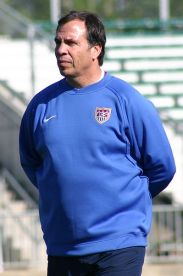
Bruce Arena managed the U.S. at the 2002 and 2006 World Cups, but missed qualification in 2018. (Wikimedia Commons)

Bruce Arena– He was brought in to steady the ship and ensure that the US would qualify for the World Cup. He failed. To be fair, as mentioned above, Arena was handed some tough cards to play with; two games played and both were losses. He had to get the results of ten games in eight games. As difficult asthe job was, it was not impossible.
Up until September, we looked good. We were undefeated and it looked like we would be fine. The loss to Costa Rica in September was tough to swallow but not damning. The US could survive that. We could not survive a loss to Trinidad & Tobago (T&T). Playing a line-up on short rest, in poor conditions, in a practically must-win game turned out to be pretty costly. Oddly, this was uncharacteristic of Arena. He rotated his squad between the home and away games of every other international break so far. I think he owns a lot of the blame for the loss to T&T and that loss is ultimately what eliminated the US. At the very least, in post-game interviews he owned that responsibility. I think people have been putting more blame on Arena than anyone else. That’s probably fair, but he’s not the only one to be blamed.

Sunil Gulati (I honestly forgot about this guy)- Gulati is the president of US Soccer Federation (USSF) and appointed both Jurgen and Bruce. First, it is strange for a national team head coach to last more than one World Cup cycle. Despite that, Sunil Gulati re-signed Klinsmann before the 2014 World Cup draw of pools even occurred. Then to keep him on after losing the 2015 Gold Cup in the semi-finals to Jamaica, and missing out on the 2017 Confederations Cup only to fire him after losing two WCQ matches really put the US in a pickle. Had Klinsmann been fired earlier, or not re-signed in the first place, the national team could have sailed a straighter course.

Then, picking Bruce Arena as a stop-gap seemed like the most logical choice at the time. And it probably was the best choice given the tough scenario. But Sunil Gulati put himself in that difficult position by waiting so long to fire Klinsmann. You reap what you sow.

The Players– As important as the above is, the team’s fate was decided on the field. And to be honest, it looked like the US were playing a preseason friendly for most of the final game that solidified their elimination. They knew what was at stake, and yet there was a decided lack of urgency to the team from the start. Despite this being the most talented and skilled USMNT ever, Alexi Lalas was right when he said that the US players were missing the grit of the old national teams. I still standby this sentiment.

Others– I will not entertain any arguments that US players playing in MLS is to blame for this. Even if it does own some level of blame in an indirect way it is negligible compared to what is stated above. In fact, besides Mexico, every other team in CONCACAF have a substantial number of national team players playing in MLS. If anything, MLS made the US’s qualifying more difficult because it has boosted programs like Panama and Honduras, not because it has deteriorated the play of American players.

800px-pulisic170727-2
Christian Pulisic is the face of the youth movement giving hope to fans of U.S. men’s soccer. (Wikimedia Commons)

Conversely, I understand the desire to use the US academy system as a scapegoat. However, players “in their prime” are the players who should have carried this team to the World Cup. Those are players ages 23 – 28ish. Those players did not show up as much as we needed them to and so we had to rely on the old-guard (Dempsey and Howard). But those “in their prime” players were in US academies approximately 10 years ago. If you believe that the US academy system has not changed since Matt Besler, Omar Gonzalez, Michael Bradley and Jozy Altidore came out of it you are sorely mistaken. The youngsters like Tyler Adams, Weston McKennie, Erik Palmer-Brown, Andrew Carleton, etc. are of a different breed of USMNT player. I am not saying that the US academy system is perfect, but it is improving and will continue to improve as time goes on.

Lastly, I will admit that I am not old enough to know this, but it feels like there are more young talented players coming out of the US than ever before. The key then, is continuing to develop those players once they join the senior team and mold them into a cohesive unit. That will be the job of the next head coach. Speaking of which …

THE PRESENT: What are the immediate next steps for US Soccer?

Changes- I would not be surprised if Bruce Arena resigns before this article is even posted online (He did). Sunil Gulati will almost certainly be out of a job as well but I do not know whether that will be of his own accord, or how quickly that will occur. USSF will definitely need to find replacements for them, but that process needs to be well thought-out, which may take some time. Plus, as much as it may not feel like it, USSF has some time, especially for the head coach position. Many head coaches looking to coach a national team may not be available until after the World Cup next summer.

USSF PresidentCarlos Cordeiro won the USSF election in Febuary. My prior speculation on this isn’t really interesting now. Jury is still out on whether Cordeiro was the right choice.

Head Coach- For the head coaching job, that will depend a lot on who is available and what the new USSF President wants. I think they will be looking for someone 1. Who is familiar with the US system/MLS 2. With national team coaching experience 3. Who has a record of developing youth. As of right now, Tata Martino of Atlanta United checks all of those boxes. Other candidates who check some of them are Peter Vermes of Sporting Kansas City, and Oscar Pareja of FC Dallas. Still, all of those names are within MLS. It is very possible that USSF look far and wide for the next head coach. A dark horse candidate that no one is talking about because he is relatively unproven is Patrick Viera (formerly) of NYCFC. He has done a very good job of getting the most out of his youth (see: Jack Harrison recently playing for the English U-21s)

For now, Dave Sarachan is the interim Head Coach. He’s done fine for an interim head coach. Since the end of the spring I’ve been rooting for Gregg Berhalter to win the position. I plan on writing a whole different column about that next week. Stay tuned.

THE FUTURE: What does the USMNT have to do to get back on track?

Owning CONCACAF- I think Matt Doyle phrased it well on “Club & Country: After the Whistle” when he said that the US needs to “start beating up on CONCACAF teams again”. The US need to be the best team on this continent before we can do anything major on the world stage. Don Garber, MLS Commissioner, has expressed similar sentiments about MLS. MLS needs to be the best league in CONCACAF before it can be compared to other leagues around the world. This is a natural progression for the league to take, and I agree with the Armchair Analyst himself that it is a progression for the US as well. (If you’re interested in soccer in the US, then Matt Doyle is a must-read)

Integrating Youth- In addition to re-becoming the shark which eats CONCACAF minnows, the US have to get better at incorporating youth into the national team. This is a separate process from developing youth in our academies. I am referring to making the leap from our youth teams to our full senior national team. For example, Matt Miazga is 22 (now 23) years old and starting in the Dutch League. Yet the most action he has seen for the senior team was one Gold Cup appearance this summer and some other cameos. At this point, he should be somewhat integrated into our center back rotation. I think Bobby Wood also integrated slowly onto this team. At this point he is in the rotation at striker but it feels like it came a year or two too late.

Dave Sarachan has laid a great foundation for this in recent friendlies. The rise of Tyler Adams, Weston McKennie, et al. bodes well for the USMNT.

Clint_Dempsey
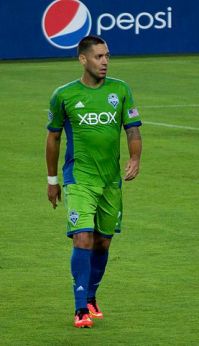
Clint Dempsey retired from international soccer in 2018, finishing his career third in caps and tied first in scoring. (Wikimedia Commons)

Saying Goodbye- Part of our problem with integrating youth is that we struggle to move on from older players. This problem will likely evaporate for a year or two as our oldest players retire (Thanks Clint Dempsey!).

With that, we have to say goodbye to some USMNT legends once and for all. Clint Dempsey, Tim Howard, and DeMarcus Beasley will never play a competitive match again for the USMNT. These guys won’t see more than one or two more caps as celebrations of their careers (Clint didn’t even get that).

Additionally, say goodbye to the roles of players aged 27-30 on this team. Michael Bradley will be on the cusp of 35 by the time the 2022 World Cup rolls around. The young end of this cohort include Jozy Altidore and Darlington Nagbe who will be 31 in 2022, but also include Gonzalez and Besler who will both be 34 by then. I do not expect the US to abandon these players completely. However, when do we let go of players of this age group? I have a feeling the 2019 Gold Cup may be the last hurrah for many of them.

Seeing how well Miazga and Brooks paired together in recent friendlies, I do not see a reason to call any older center-backs. I still think Jozy and Nagbe could be useful for this team, especially over the next two years. After that I really hope some youth beat them out for their positions. After recent reports of Bradley’s ‘alpha dog’ mentality, I honestly think his presence will only be a hindrance.

Looking Forward- And with that I will leave everyone with some hope that it will get better from here. Christian Pulisic, the wonder-boy himself, the most talented player is US history, is only 20 years old. He played in that elimination game and you can bet he will never forget it. The most expensive player is US history (who was injured for the last few qualifiers), John Brooks, is 25 years old. The US U-20 team made it to the quarterfinals of the U-20 World Cup this summer without Pulisic and Shalke midfielder Weston McKennie and other notable absences. Their only loss was to the team that ended up getting second place. 19 year old Tyler Adams scored his first USMNT goal against Mexico. The future is bright.

After another year, I have some idea on who should be key players going forward. At this point, I would definitely put Pulisic, Adams, McKennie, Brooks, Miazga, Yedlin, and Steffen on the field for a must win game. The other four starting positions are still up for grabs, which is fine for now. Our next competitive game is in the summer of 2019 and it’s the Gold Cup. Don’t get me wrong, I want to win the Gold Cup, but if we’re still working out a kink or two I won’t cry about it.

But I’m getting ahead of myself. Before we worry about that we should worry about who the head coach is going to be. Come back next week to hear my thoughts on the head coach search!