Solving college basketball’s one and done problem

Every year we see it at Kentucky. A bunch of 19-year old kids leave school after just one year, as they enter the NBA draft. They leave behind an incomplete education with hopes of making millions in professional basketball.

Karl-Anthony_Towns
Karl-Anthony Towns only spent one year at Kentucky, but has transitioned well to the NBA. (Wikimedia Commons)

Kentucky isn’t the only school where this is happening though, as it has morphed into a problem across the entire NCAA landscape. This “one and done” phenomenon is a product of the NBA’s rule requiring players to spend one year in college or playing overseas before entering the league’s rookie draft. This leads to several, I won’t say all, student-athletes heading to school to essentially major in basketball.

They take a couple of classes to keep their GPA up to be eligible for the basketball season and then leave school after one year with no real education. This year, we saw potential number one overall pick Ben Simmons withdraw from classes early, after the season had ended so he could focus on training for the upcoming draft combine.

Many of these players make millions at the next and have no need for an education, but for those who fall through the cracks and fail to take hold in the league, they suddenly find themselves out of a job without a college education.

The quality of play has dropped off as well. Back in the best days of college basketball, you had players staying for three or four years at their respective schools, developing into polished players before making the jump to the pros.

Think back to the days when Larry Bird, Michael Jordan, James Worthy, Patrick Ewing and so many others stayed in school long enough to become superstars and transcend college programs. College basketball lacks that right now, with very few of the game’s top players staying for more than a year at the collegiate level.

That is what college basketball needs to increase the level of play again. The NBA could use the same thing to be honest. Most of these rookies enter the league and require a year or two essentially sitting on the bench or playing in the D-league because they aren’t ready to compete at the next level yet. Very few come in as polished products ready to contribute on day one.

Tyler Ennis
Ennis was drafted in the first round in 2014 by the Phoenix Suns. (Wikimedia Commons)

Look at Tyler Ennis as an example. He had one great year at Syracuse and then decided to make the jump to the pros. Ennis would have benefited from another year in college, but as a result of the one and done culture, felt that he needed to enter the draft. Over the last two years, Ennis has only played 79 games, averaging around 14 minutes per game. He is constantly bouncing back and forth from the NBA to the D-league and while he is still young, his NBA career has gotten off to a very slow start.

Ennis is far from the only one either. Anthony Bennett failed to translate to the NBA after just one season an UNLV. Austin Rivers is still only a role piece as he left Duke after just one year.

To solve all of these issues, the NCAA and the NBA needs to work out a new structure for how long college athletes must stay in school and about the requirements of going to school.

The NCAA should adopt a system similar to what it has set up for college baseball. Players are not require to play a year before entering the professional draft. However, if these high schoolers decide to attend a college as a student-athlete, they must spend three years at the school before they can enter the draft. I would also like to add some other provisions as well.

Universities would be required to honor a player’s scholarship if he chose to come back and finish his degree after his playing days had ended or if he decided to complete it during the summer. They would also be required to honor the scholarship of student-athletes in the event of an injury that cost them their career.

This system would actually solve so many different issues. First and foremost, players would finally have a more complete education having to finish three years of school rather than just one. That additional year required to finish most undergraduate degrees would be much easier to complete at a later time and the athletes would have it covered by their scholarship. The student-athletes would also be able to continue their education in the event of an injury, which happens way too frequently and results in a loss of scholarship.

While it seems like the NCAA is giving up a lot here, there would be some major benefits. To start, they would see a huge jump in the quality of play for college basketball. With players staying school longer, they can become more marketable to fans and television networks, meaning an uptick in revenue.

The schools would also see an increase in Academic Progress Ratings. The NCAA describes this as, “hold[ing] institutions accountable for the academic progress of their student-athletes through a team-based metric that accounts for the eligibility and retention of each student-athlete for each academic term.” With a higher retention rate and increased graduation rates of players, schools would be able to boost their ratings.

College basketball as a whole would benefit from this system as the talent would begin to spread. With student-athletes staying school longer, coaches would not need to recruit as heavily each year, which would mean that players would have to start looking at schools other than the traditional powerhouses if they wanted playing time right away.

We would also see an improvement in play at the NBA level. The guys who are ready to compete right out of high school would no longer have to waste a year playing college ball without a real educate in place. There are still plenty of them that transition seamlessly into the pros after just one season in college. Those who need a little time to develop would have three whole years to hone their skills and refine their game before jumping to the NBA. That would lead to an increase in pro-ready prospects.

This system is not perfect, but it is certainly a step in the right direction when it comes to repairing the current dysfunctional method to college basketball.
Uncertainty at the top of men’s college basketball

We are in the thick of the NFL playoffs, but it is time to take a short break from football and focus on the odd phenomenon occurring right now in the world of men’s college basketball.

NCAA_logoThis is the eleventh time this season that college basketball has seen a set of top 25 rankings. For the fifth time already this year, there is a new team atop those rankings, this time in the form of Oklahoma.

However, the Sooners just took a major loss to Iowa State on the road and it is likely that we will see Oklahoma drop from the top spot. Looking at how the schedule is shaking out right now, North Carolina will likely vault back into the top spot. That would represent the sixth change at the top of the poll in just the first 12 weeks.

Talk about a lack of continuity. Six changes through 12 weeks is the most we have seen since 1994, when we had seven changes in those first dozen weeks. North Carolina would be returning to the top spot, but it would be for the first time since the second poll of the season.

After last season when Kentucky went wire to wire as the number one team, this switch to parity seems kind of odd.

In addition to the top 25 failing to find a consistent king, the power five conferences have some unfamiliar faces at the top. The ACC seems pretty uniform with North Carolina perched at the top, with an unblemished conference record. Everywhere else, we are seeing the preseason favorites failing to live up to the hype.

In the Big 12, Kansas, who has dominated this conference for the majority of the last decade, sits behind Baylor. It might only be a one game lead, but Baylor jumping out to this spot about halfway through conference play is surprising.

Looking over at the Big 10, Michigan State has a losing record in conference play. Ohio State isn’t at the top either. Indiana leads the conference with a perfect record so far. Right behind them is Iowa. Odds are this one will shake out as we expected with a modern power back at the top, as Iowa and Indiana match up twice before the end of the season. Indiana also has games at the Big House, East Lansing and in College Park. Iowa still has some tough games on the slate too.

The PAC 12 is all over the place. It’s not Arizona, Stanford or UCLA at the top of the conference, but Washington. Washington, who hasn’t won the PAC 12 regular season title since 2011. Only half a game behind Washington is USC, who hasn’t won a regular season conference championship since 1985. Arizona and UCLA, who have won the last three regular season conference titles, file in at third and seventh respectively. Far from out of the picture, but there is definitely a changing of the guard going on here.

However, the conference with the most confusion has to be the SEC. The conference has been dominated by Kentucky, even during down season’s for the Wildcats. If Kentucky did not win, then it was Florida who stole the regular season title. The last time a team that was the Wildcats or the Gators won the SEC regular season crown was 2009, when LSU captured the top spot. This season, the conference is being dominated by Texas A&M and South Carolina. Both schools find themselves in the top 25 and A&M has a nice spot in the top 10.

In an era of one and dones, we should have always expected for the traditional power to break and for others to rise. Yet, somehow we didn’t. We all expected Kentucky to continue its run at the top. Many figured Virginia would be a national power, following their back-to-back ACC titles. Instead, the Cavaliers have lost four games to unranked opponents. Gonzaga also figured to be a consistent top 25 team, but close losses have knocked them from the rankings altogether.

This should not be anything shocking. It is just a friendly reminder why we should all love college basketball. It is also the first signs that college hoops might finally have some parity. The constant rotation of number one teams and the new faces atop the conference indicate that there is some room for turnover. SMU is the only top 25 team who still has a zero in the loss column. Like I said, for some, this is just a reminder. For others, it is an assurance that college basketball is trending in the right direction and should always command your attention.

Oh and this definitely bodes well for March.

What if Chip had stayed at Oregon?

The Eagles have been the most scrutinized team in the NFL since Chip Kelly arrived in Philly from the Pacific Northwest. He brought with him a college style of coaching and a new offense that many assumed could not work at the professional level. He has burned more than his fair share of bridges as well with many of his now former players.

Chip_Kelly
Kelly had a 46-7 record in his five years at Oregon before leaving for Philly.

For better or worse, Chip has completely changed the landscape of the NFL in his three years as head coach. But what if he had never left? What if Kelly had decided to stay out at Oregon and run his fast-paced offense? That is exactly what we are going to talk about right now.

Well first thing is first, the Eagles need a new coach when Andy Reid is fired following the 2012 season. So Philly brings in current Minnesota head coach Mike Zimmer. Zimmer was tabbed by Minnesota in 2014 but because he is still a coordinator in Cincy in 2013, the Eagles snap him up instead.

The team approach for Philly completely changes. Zimmer brings in a defensive presence to an Eagles team that desperately needed it. Philadelphia had ranked tied for 29th in the league in 2012 for scoring defense. Needless to say, Zimmer would look to bring in some fresh faces. Needing a solid defensive end, Philly targets Michael Bennett from the Bengals in offseason and avoids letting Dominique Rodgers-Cromartie walk away.

Michael_Bennett
Bennett won a ring in 2013 with the Seattle Seahawks.

Already the defense looks better and some very important things happen for the Eagles offense. Zimmer never isolates DeSean Jackson so he stays and there is no push a year later for Jeremy Maclin or LeSean McCoy to leave. Todd Herremans and Evan Mathis never feel unwelcome either. Philly keeps together their core together instead.

2013 proves to be an excellent year for Philly as they once again capture the NFC East crown, but this time, Zimmer gets a playoff win against New Orleans, as his defense finds a way to limit Drew Brees on the road. The Eagles travel to Carolina the following week and pick up a big victory against the favored Panthers. Philly runs into a buzz saw in the form of Seattle in the NFC Championship game though and sit at home as the Seahawks blow out the Broncos. Overall though, it is a very positive start to the Zimmer era in Philly.

Meanwhile, in Oregon, the Ducks enter the season as a team with major National Title aspirations again but have a legitimate chance of getting the job done with Kelly at the helm. He and sophomore quarterback Marcus Mariota manage to go the whole season with just one loss, a blowout defeat against Arizona. Kelly calling the shots proves to be enough for Oregon to beat Stanford and hold onto their title aspirations much longer. Instead of finishing 10th in the standings, the Ducks finish fifth and earn a spot in the 2014 Rose Bowl in place of Stanford.

Zimmer continue to prepare his team for a very important 2014 campaign though over in Philadelphia. His core of McCoy, Jackson, Maclin and rookie Jordan Matthews pace the offense and make life easy on Nick Foles. The defense, led by Michael Bennett, Trent Cole, Connor Barwin and rookie Bradley Roby, proves to do enough for Philly to make the playoffs in 2014 instead of just missing out. The team moves forward mainly due to avoiding a late season loss to Washington.

The Eagles enter the postseason with a matchup against Dallas on the horizon. The Cowboys split the regular season series with Philly but they lost at home then and they do again here. That mean Philly travels to Seattle for the divisional round and for the second straight year, the Eagles fall against the Seahawks in the playoffs.

Marcus_Mariota
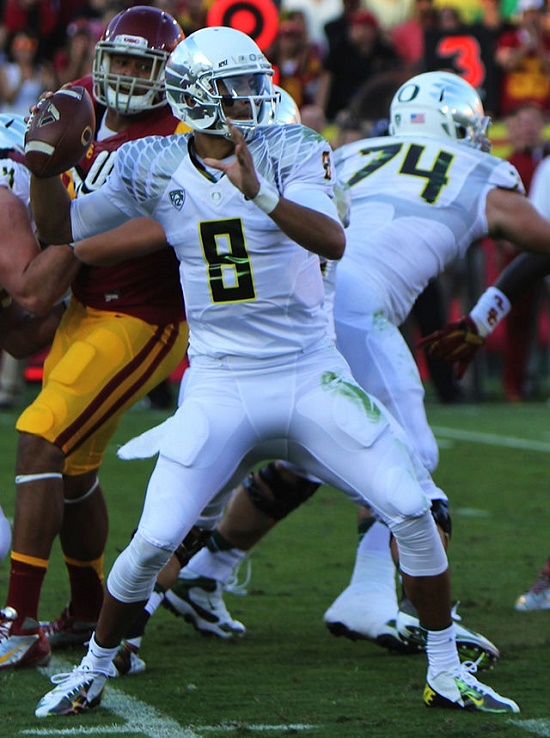
Mariota was the second overall pick in the 2015 NFL draft.

Checking back in on the West Coast, Marcus Mariota is tipped to be the Heismann winner with Kelly at the helm. Oregon is coming off a Rose Bowl win and looks to be a lock for the College Football playoff. They finish the season with just one loss for the second consecutive year under Kelly, the loss once again coming against rival Arizona. Mariota bolsters his draft stock in his junior season and takes home the Heismann Trophy by a landslide. Oregon still ends up in the National Title game, still against Ohio State. The game ends a lot closer this time around but still in an Ohio State win.

The 2015 NFL draft rolls around and after his transcendent performance under Kelly at Oregon, Mariota leapfrogs Jameis Winston in the predraft build up. Mariota goes number one overall to the Tampa Bay Buccaneers and Tennessee is left to take Winston second.

Damarious_Randall
The Packers selected Randall with the 30th pick in the draft.

Later on in the first round, selecting after the would’ve this year, the Eagles instead take Arizona State safety Damarious Randall to bolster the secondary then draft the troubled Randy Gregory in the second round. Now, Zimmer has all of the pieces he wants to play with on defense and Philly enters the season as an early season favorite to win the NFC instead of a team with dozens of questions surrounding it.

McCoy never winds up in Buffalo, Maclin never joins Andy Reid in Kansas City. DeMarco Murray and Ryan Mathews never join during the offseason. Instead, Mathews heads to Tennesee to help the rebuilding Titans. Murray takes his talent (or lack there of) to Baltimore.

Who would’ve thought that the NFL would change this much just because Chip Kelly decided to stay at Oregon.